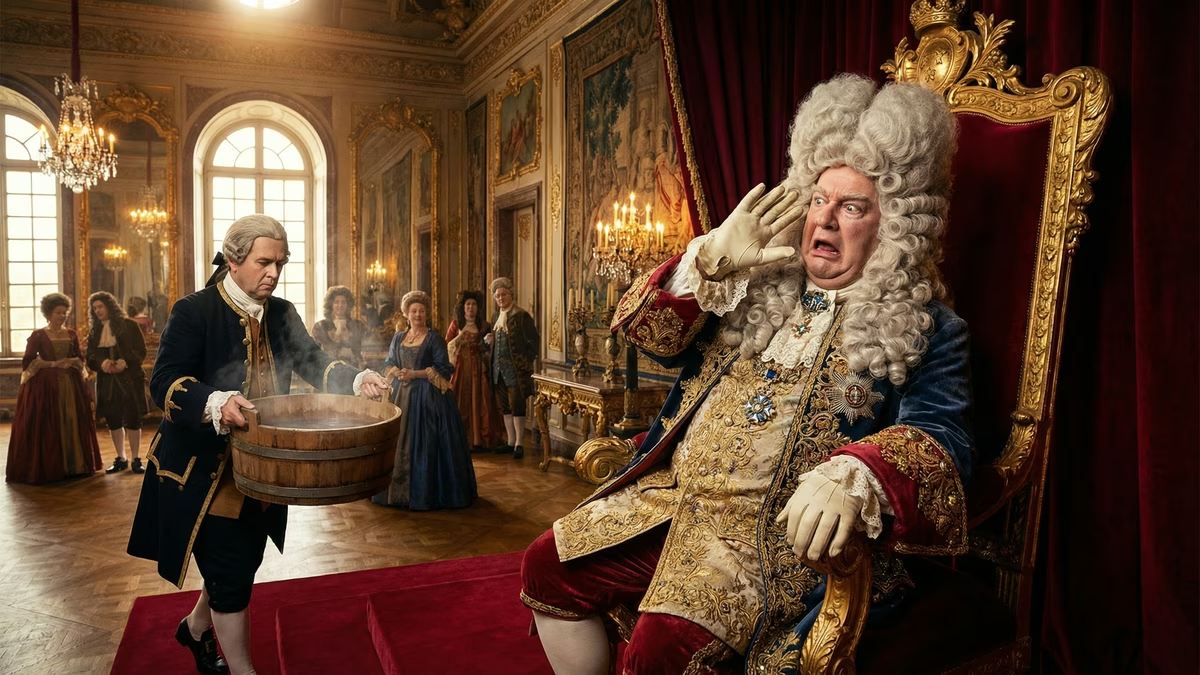
The Royal Stink: An Introduction to History's Most Powerful Odors
Imagine being the most powerful person in the world. You have armies at your command. Palaces made of gold. A wardrobe that costs more than a small country. And you smell absolutely terrible.
Welcome to the glamorous life of European royalty.
For centuries, the kings and queens of Europe were genuinely, deeply, philosophically terrified of taking a bath. We're talking about people who would rather wear a pound of perfume than touch a bar of soap. But here's the twist: they weren't just lazy. They thought bathing would literally kill them. And honestly? Given what passed for medical advice back then, they had their reasons.
The Miasma Theory: When Your Doctor Was Your Worst Enemy
To understand the royal fear of water, you have to understand the "miasma theory." This was the dominant medical belief for centuries, and it went something like this: diseases are caused by "bad air." Invisible, toxic vapors rising from rotting things. And if you took a hot bath, your pores would open up and all that disease-ridden air would rush straight into your body.
Let that sink in. The official medical advice was: do not get clean, or you will die.
So when a king refused to bathe, he wasn't being disgusting. He was following doctor's orders. He was being responsible. He was, in his mind, basically wearing a suit of armor made of his own filth. Which is a sentence I never thought I'd write, but here we are.
The irony? The miasma theory was completely wrong. Germs cause disease, not bad air. But nobody figured that out until the 1800s. So for a solid few centuries, the smartest people in Europe were confidently telling their monarchs to stay dirty. And the monarchs, bless them, listened.
Louis XIV: Three Baths, Seventy-Six Years, Zero Regrets
Let's talk about King Louis XIV of France. The Sun King. The man who built the Palace of Versailles, the most extravagant building in human history. He had 700 rooms, 2,000 windows, and 1,400 fountains. You know what he didn't have? Bathrooms.
Louis XIV is reported to have taken only three baths in his entire life. Three. He lived to be 76. Do the math. That's roughly one bath every 25 years.
Instead of bathing, Louis and his entire court relied on perfume. Not a little spritz. We're talking industrial quantities. The French court became literally known as "the Perfumed Court" because they doused everything — their clothes, their furniture, the walls, the fountains — in fragrance. Louis had his personal perfumer create a brand new scent for every single day of the week. His shirts were rinsed in a special mixture of aloes-wood, nutmeg, rosewater, jasmine, and musk.
His mistress, Madame de Montespan, reportedly wore extra-heavy perfume specifically because she couldn't stand the smell of her royal lover. That's the most politely devastating thing anyone has ever done to a king.
King James I: The Monarch Who Feared Soap More Than War
Louis XIV wasn't alone in his aquatic avoidance. King James I of England (the same guy who commissioned the King James Bible, so he had at least one good idea) was famously said to never bathe at all. Not occasionally. Not rarely. Never.
Contemporary accounts describe the rooms he occupied as being filled with lice. He reportedly wouldn't even wash his hands before eating. At the dinner table. The king. Of England.
To be fair to James, historians debate how literally true these accounts are — some of it may be political smearing by his enemies. But the fact that "he never bathed" was a believable and widely circulated insult tells you everything you need to know about the hygiene standards of the era.
Queen Isabella's Legendary Vow
Then there's Queen Isabella I of Castile, who helped fund Christopher Columbus's voyage to the Americas. According to legend — and historians debate this one too — Isabella bragged that she had only bathed twice in her entire life: once when she was born, and once on her wedding day.
She allegedly made a vow during the siege of Granada in 1491 not to change her clothes until the city fell. The siege lasted months. Her subjects, inspired by her sacrifice, reportedly started wearing the same yellowish-beige color in solidarity. That color? It became known as "Isabella." It is still a recognized color in heraldry today.
So the next time someone asks you why you're not doing laundry, just tell them you're honoring a 500-year-old royal tradition.
Wait, Did Medieval People Actually Bathe?
Here's where it gets genuinely interesting. The popular image of the filthy, never-bathing medieval peasant is actually kind of a myth. In the Middle Ages, public bathhouses were everywhere. Paris had over 32 bathhouses by the 13th century. London had 18 in just one neighborhood. Medieval people liked being clean. They just had a different relationship with it than we do.
Things changed dramatically after the Black Death. When the plague wiped out a third of Europe's population, people started looking for explanations. Some doctors blamed the bathhouses — all those open pores, all that shared water. Suddenly, bathing went from normal to dangerous. The philosopher Erasmus noted in 1526: "Twenty-five years ago, nothing was more fashionable than the public baths. Today there are none. The new plague has taught us to avoid them."
So the royal fear of bathing wasn't ancient tradition. It was a relatively recent development, born from genuine terror of disease, and it stuck around for centuries because nobody had a better theory to replace it with.
The Mic Drop: Cleanliness Was a Revolution
It wasn't until the 19th century that germ theory finally replaced miasma theory, and suddenly everyone realized that washing your hands was, in fact, a good idea. The shift was so dramatic that doctors who advocated for handwashing — like Ignaz Semmelweis — were initially laughed out of the medical establishment. His colleagues thought he was insane for suggesting that doctors were spreading disease by not washing their hands between patients.
He was right. They were wrong. And the kings of Europe had been wrong for centuries before that.
So the next time you take a shower, take a moment to appreciate the fact that you live in an era where "please wash yourself" is not considered radical medical advice. You are cleaner than Louis XIV. You are cleaner than King James I. You are, in this one specific and extremely important way, doing better than the most powerful people who ever lived.
History is wild. And occasionally, it smells.
Sources & More Reading
- History.com: Naked Cooks, Excrement, Rats — The Secretly Disgusting History of Royal Palaces — A deep dive into the filthy reality of life inside royal palaces, from Henry VIII's lice problem to the stench of Versailles.
- The Perfume Society: Louis XIV, the Sweetest-Smelling King of All — How the French court replaced bathing with industrial-scale perfumery, and why Louis had a new scent for every day of the week.
- Brewminate: When Cleanliness Was Dangerous — A thorough academic breakdown of the miasma theory and why Europeans genuinely believed bathing could kill you.
- Medievalists.net: Did People in the Middle Ages Take Baths? — The surprising truth about medieval bathhouse culture and how the Black Death changed everything.
- HistoryExtra: The (Not So) Stinky Middle Ages — Why medieval people were actually cleaner than we think, and when that changed.